




















Human Skills in a Machine Age
Introduction: Ever pondered how often we use physical dictionaries nowadays? A child once found a new word by opening a thick book, following the alphabetical order, checking the spelling, turning pages, and then arriving at the meaning. Today, one can simply Google the word or ask an AI assistant. The answer appears on the screen in seconds. The question is not whether the new method is faster. It is: what happens to the human skills we stop practising?
Table of Contents
The Role of Effort in Learning
Using a physical dictionary, in itself, was not always the end goal. According to Wright and Cervetti (2017), when the objective is learning a word’s meaning, too much of dictionary use can increase cognitive load and take attention away from the word itself. However, dictionary use also required children to practise spelling, alphabetical order, searching, reading definitions, comparing meanings, and choosing the meaning that fitted the context. According to Collins, learning to use a print dictionary develops skills that can also help with other kinds of learning. So, the point is not that paper is better than technology. The point is that some effort is part of learning.
Developing Critical Thinking
This becomes significant in the age of machines as they can give answers, organise information, and do many time-consuming tasks quickly. The danger is not simply that machines become smarter. The danger is that humans may stop exercising abilities because machines can do them for us. According to Danielle Wallace, people must develop critical thinking and not simply hand over decision-making. We must question machine-generated recommendations and use our own understanding of the situation before accepting them.
Facing Challenges
Researcher Matt Beane says that people develop skills through meaningful challenge and through relationships between learners and experienced people. His work warns that intelligent technologies can interfere with these traditional ways of learning. If technology removes every difficult step, we may get the answer without developing the ability behind it. A shortcut can save time, but it can also remove practice. This makes skills such as independent learning, problem-solving, and the ability to learn through experience even more important.
Use AI Wisely
This does not mean we should reject AI altogether. AI can help us learn, find information, and reduce repetitive work, which can increase efficiency. But we must also critically analyse its pros and cons. We can ask AI for an answer and still ask why it is correct. Just as we can use a calculator and still understand the mathematics, we can use AI without giving up our own thinking.
Essential Human Skills
Therefore, the human skills that matter in a machine age are not only technical skills. They include curiosity, critical thinking, judgment, creativity, communication, empathy, problem-solving, and independent learning. According to the research on developing human skills in the age of machines, humans need to be especially strong in understanding context, framing problems, questioning AI-generated decisions, and applying their own judgment. Similarly, research from McKinsey highlights judgment, relationship-building, critical thinking, and empathy as abilities that remain important as AI takes over more routine tasks.
Conclusion
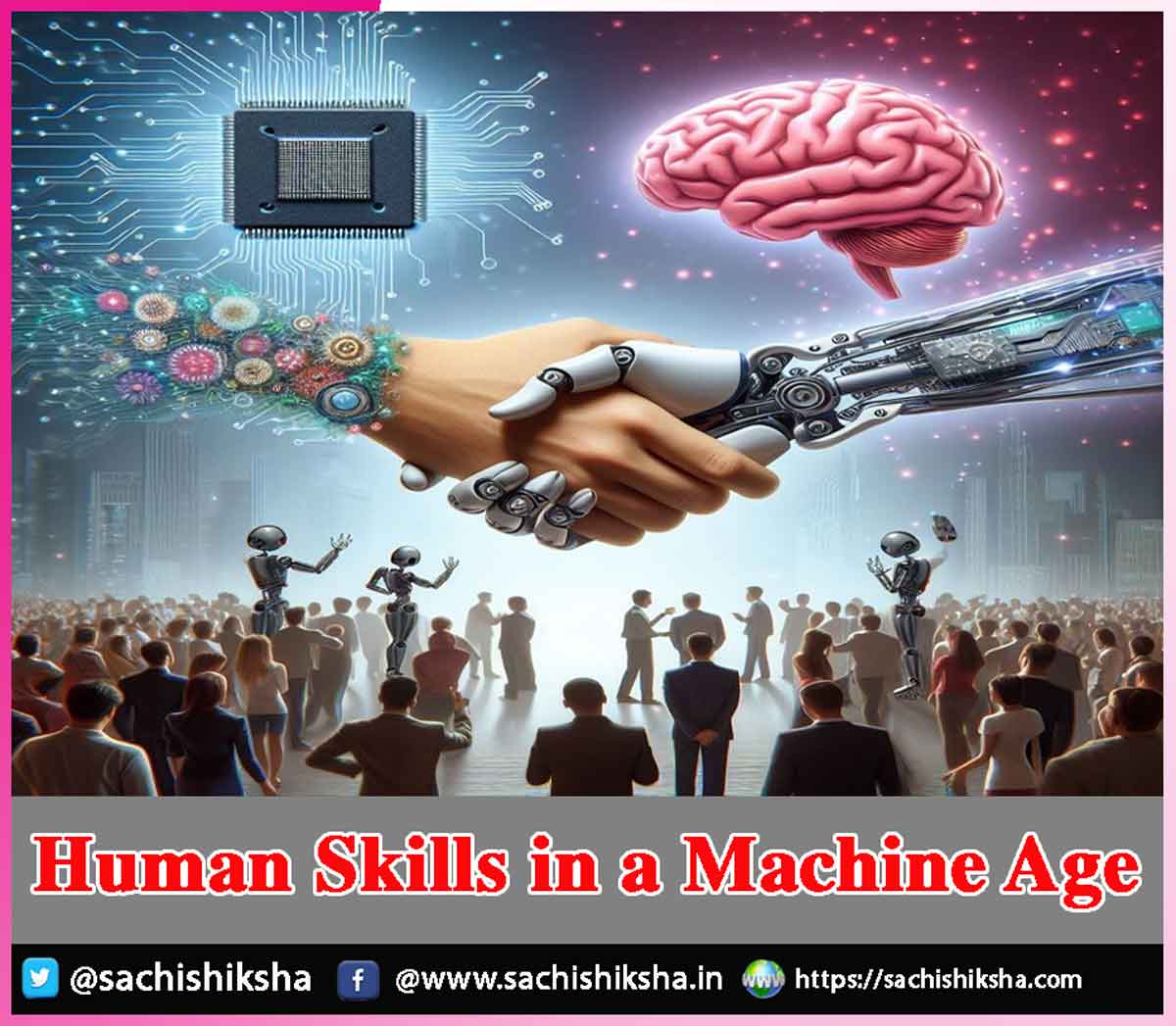
The future should not be humans versus machines, but humans using machines as tools, and never vice-versa. We should allow technology to make our work easier and faster, while continuing to practise the skills that need our human judgment, curiosity, creativity, empathy, and understanding. In the machine age, the important question is not simply what machines can do for us, but what we must continue to do for ourselves, so that we can think independently, and make informed and responsible choices.