























Silence: The Key to Hearing the Inner Voice
Today’s era is an age of hyper-connectivity and continuous communication. From the moment a person opens their eyes in the morning until going to sleep at night, they live amid a constant barrage of words, information, mobile notifications, and thoughts.
In such times, the greatest irony is that human beings have learned to speak, but forgotten how to remain quiet. Yet the truth is that the deepest power of the world lies not just in words, but is hidden in silence.
Silence is not merely the act of staying quiet; it is an inner state in which peace, energy, self-reflection, and self-awareness are experienced. Just as the blank space between two words gives meaning to those words, silence brings depth and meaningfulness to life amid its constant rush.
Table of Contents
Importance of Silence in Spirituality
In Indian culture and spirituality, silence has been considered sacred. Here, silence is not restricted merely to stopping speech; rather, it is regarded as a medium for self-reflection and spiritual practice (sadhana). One who contemplates is called a Muni, and one who masters silence becomes powerful from within.
According to Lord Krishna in the Srimad Bhagavad Gita, speaking truthful, pleasant, and beneficial words is considered an austerity of speech (Tap), but silence is higher than even that. Lord Shiva, in his Dakshinamurthy form, resolves the doubts of his disciples without speaking. This symbolizes that profound truths are revealed not through words, but through silence.
In Yoga Shastra, silence is considered an important part of Pratyahara (withdrawal of the senses). When a person stops communicating with the external world, inner dialogue begins. In the Buddhist tradition, silence is considered a medium for purifying the mind in meditation and Vipassana. Silence conserves the mind’s scattered energy and focuses it towards memory, concentration, and self-awareness.
Science Also Accepts the Power of Silence
Modern science has now acknowledged the importance of silence. Scientific research reveals that silence is not just the absence of sound, but acts as a ‘reset button’ for the brain. A 2013 study on neuroplasticity found that spending time in silence daily leads to the development of new cells in the hippocampus region of the brain. This same region is linked to memory power and learning capacity.
Constant noise and information overload increase stress, anxiety, and high blood pressure, whereas even a few minutes of silence lowers cortisol (stress hormone) levels and calms the mind. According to scientists, when a person remains quiet for a while without external disturbance, the brain’s “Default Mode Network” becomes active, which is responsible for creativity and self-analysis.
Silence and Mental Health
According to psychology, silence does not mean moving away from external noise alone, but also calming the noise within. The mind remains constantly entangled in thoughts, worries, and imaginations. It relaxes the mind and brings a person closer to themselves. In meditation as well, silence is considered the most important practice. When a person sits in silence, they are able to feel their breath, thoughts, and emotions more clearly.
This very process leads towards self-knowledge and mental balance. Today, in this era of social media and digital information, humans have connected with the world, but are drifting away from themselves. In such times, silence offers a person the opportunity to return within. This is why psychologists also consider silence a ‘natural therapy’.
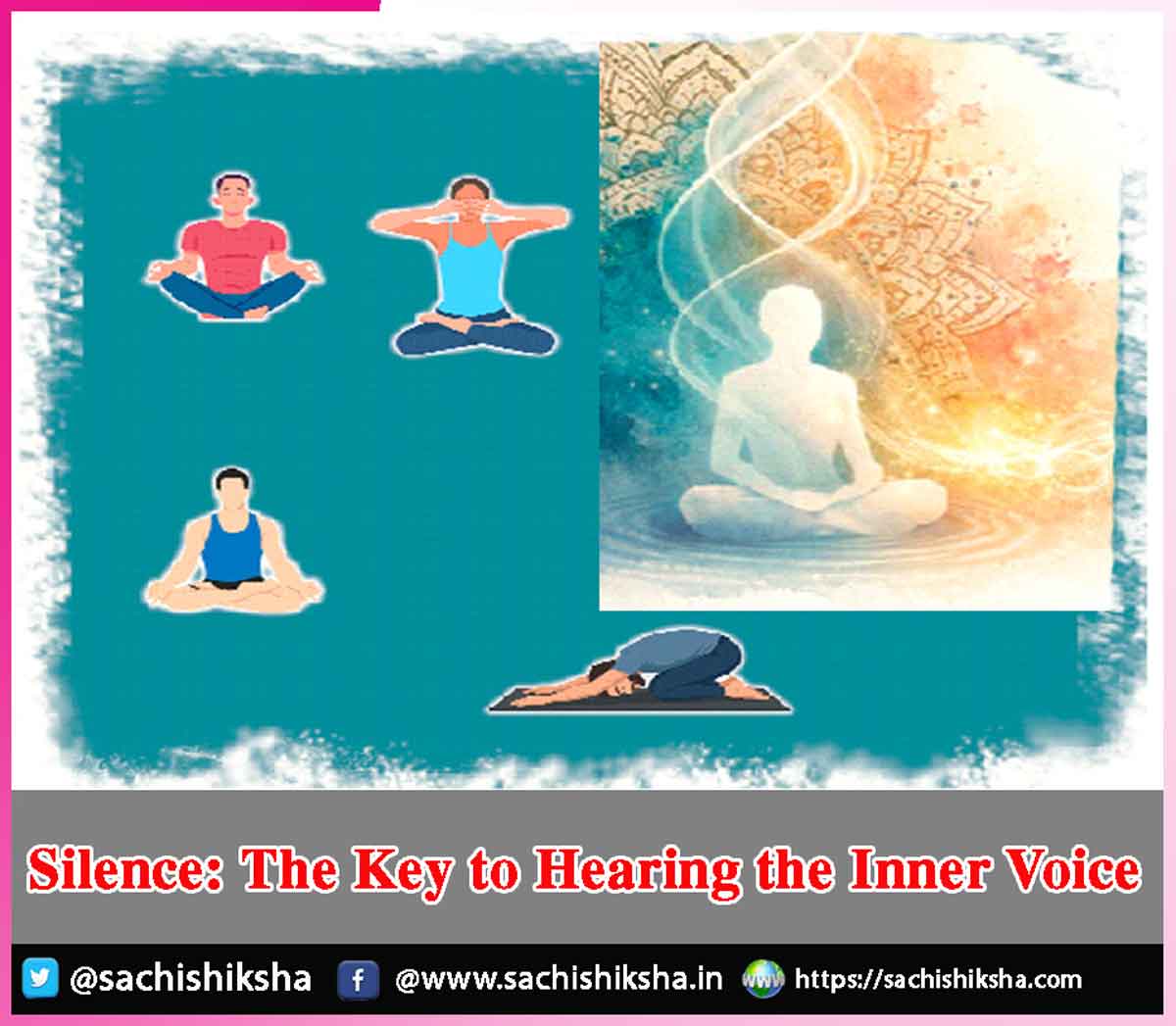
Practice of silence is mainly performed with Padmasana, Sukhasana, Balasana, and Bhramari Pranayama. In yoga, silence is not merely stopping vocal speech, but a deep state of calming the mind.
Benefits of Practicing Silence
- Reduces mental stress and decreases cortisol hormone levels.
- Saves energy otherwise spent on speaking, directing it towards self-reflection.
- Calms mental turmoil and deepens focus.
- Settles unnecessary thoughts, making decision-making easier.
- Keeps heart rate normal.
- Prevents saying bitter or incorrect words.
- Offers an opportunity to know oneself deeply from within.
- Improves relationships and avoids unnecessary arguments.
Yogic Postures Shown
- Sukhasana (Easy Pose): Sit cross-legged in a comfortable position, keeping the spine straight and eyes closed; focus on breathing.
- Bhramari Pranayama: Close ears gently with thumbs, place index fingers on the forehead, and remaining fingers over eyes/face. Keep eyes closed, make a humming bee sound to calm the nervous system and mental noise.
- Padmasana (Lotus Pose): Fold the right knee to place foot on left thigh, and left knee to place foot on right thigh. Best pose for making the mind completely stable and focused.
- Balasana (Child’s Pose): Performing Balasana as shown in the illustration provides immediate relief to the body and nervous system.
How to Adopt Silence in Life:
- Making silence a part of daily life is not difficult. Spending some time daily without mobile devices, talking, or distractions is a good starting point.
- Sit in silence for 10–15 minutes daily. Spend time in nature, practice meditation and breath awareness, and avoid unnecessary speaking. Keep distance from digital devices for a few moments each day.
- These small habits can bring deep transformation within. Silence is not emptiness; it is a state housing peace, life energy, and infinite power.
- Religion has always directed us towards silence, and science now validates its physical and mental benefits.
- Midst the noise of life, silence is that stable center which keeps us balanced from within. Silence does not mean just remaining quiet, but understanding oneself and realizing the true meaning of life. Perhaps this is the path that frees people from external noise and connects them with their inner truth.