
























The Mathematics of Everyday Life
Introduction: Mathematics is often associated with classrooms, textbooks, formulas, and examinations. However, mathematics is not limited to numbers written on a blackboard. It quietly shapes almost every part of our daily lives. From managing money and planning our time to cooking food and deciding the fastest route to work, we use mathematical thinking more often than we realize.
Table of Contents
Money Management
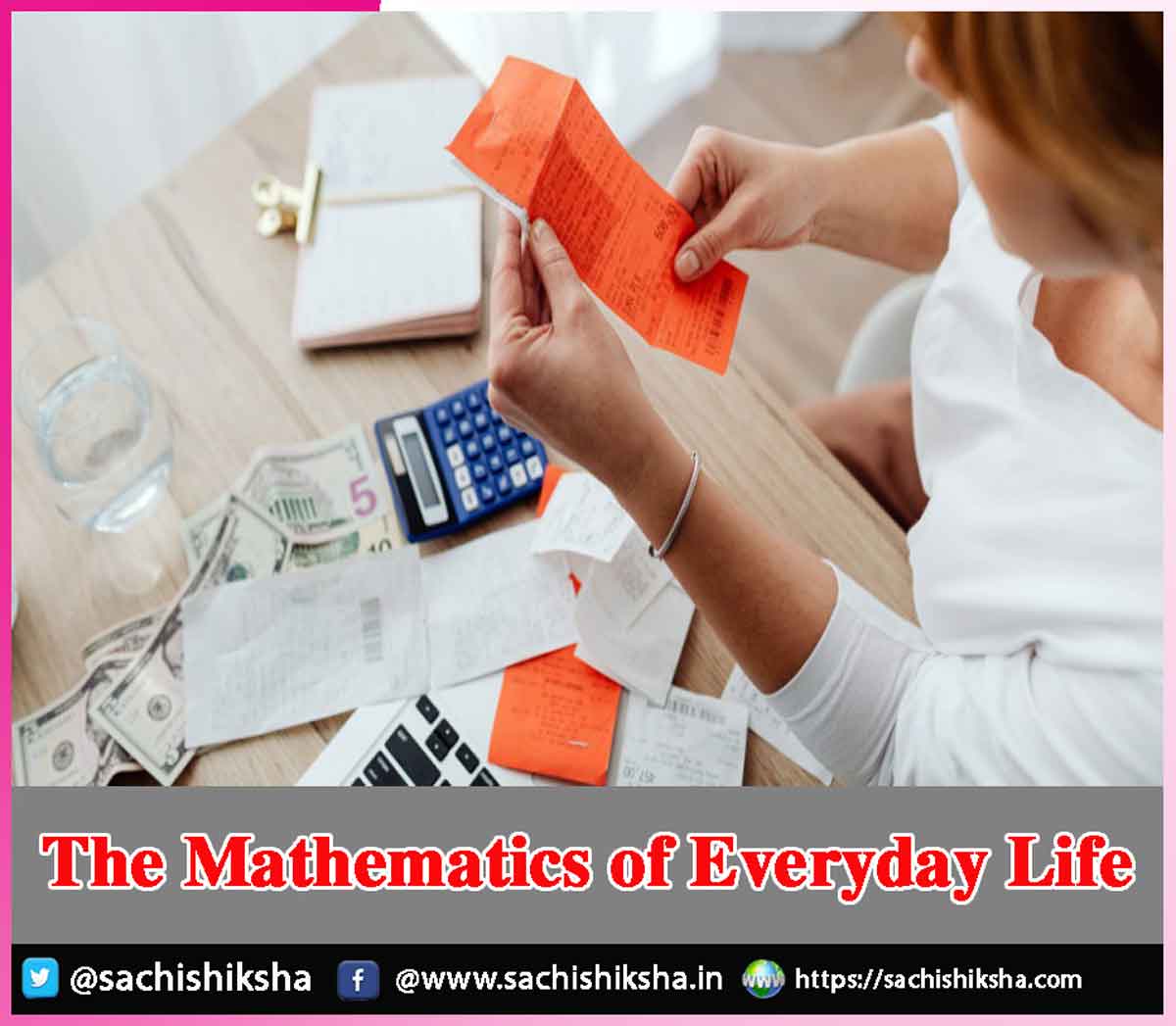
One of the most obvious examples is money management. Every day, we make decisions involving addition, subtraction, percentages, and comparison. When shopping, we calculate discounts to determine whether a product is actually worth buying. If a shirt costs ₹2,000 and is offered at a 25% discount, we know that the final price is ₹1,500.
 Similarly, when planning a monthly budget, we divide our income among rent, food, transportation, savings, and other expenses. Understanding interest rates also helps us make informed decisions about loans, credit cards, and investments. In this way, basic mathematics becomes an important financial skill.
Time Management
Time management is another area where mathematics plays a major role. We constantly calculate how long it will take to complete tasks, travel to a destination, or prepare for an event. If we need to reach the office by 9:30 a.m. and the journey takes one hour, we know that leaving at 8:30 a.m. is necessary. When several tasks compete for our attention, estimating the time required for each helps us organize our schedules. Even something as simple as deciding when to sleep depends on calculating how many hours of rest we can get before waking up.
Mathematics in the Kitchen.
Mathematics also appears in the kitchen. Recipes depend heavily on measurements and proportions. If a recipe serves four people but we need to cook for eight, we may need to double every ingredient. Similarly, measurements such as cups, grams, litres, and teaspoons help us maintain the right balance of ingredients. Temperature and cooking time are also mathematical considerations. A small error in measurement can sometimes change the entire result of a dish.
Mathematics in Travel
When we travel, mathematics becomes part of our decision-making process. We compare distances, speeds, fuel consumption, ticket prices, and travel times. Navigation applications use complex mathematical calculations to identify routes and estimate arrival times. Even without technology, people naturally compare different routes based on distance and time. For example, a longer road may sometimes be faster if it has less traffic. This involves comparing multiple variables before making a decision.
Homes and Surroundings
Our homes and surroundings also demonstrate mathematics. Architects and engineers use geometry, measurements, angles, and proportions to design buildings and structures. At home, we use similar concepts when arranging furniture, measuring a wall for a painting, calculating the amount of flooring required, or deciding whether an appliance will fit into a particular space. Patterns and symmetry, which are mathematical concepts, can also be seen in architecture, decoration, and nature.
Role of Technology
Technology has made mathematics even more deeply integrated into our lives. Every time we use a smartphone, search engine, banking application, or social media platform, mathematical algorithms are working behind the scenes. They help process information, identify patterns, calculate recommendations, and protect digital transactions. Although users may never see the equations involved, mathematics is an essential part of the technology they use every day.
Importance of Mathematical Thinking
Perhaps the most valuable role of mathematics is not simply calculating numbers but developing logical thinking. Mathematics teaches us to identify patterns, examine information, compare possibilities, and solve problems step by step. These skills are useful even when no numbers are involved. Deciding how to organize a busy day, comparing job opportunities, or finding a practical solution to a problem can all involve mathematical thinking.
Conclusion
Ultimately, mathematics is not something that exists only in classrooms. It is present in our wallets, calendars, kitchens, workplaces, homes, journeys, and digital lives. We may not consciously perform calculations every time we make a decision, but mathematical principles constantly influence the way we understand and interact with the world. The mathematics of everyday life reminds us that numbers are not merely symbols in a textbook—they are tools that help us make sense of life itself.