























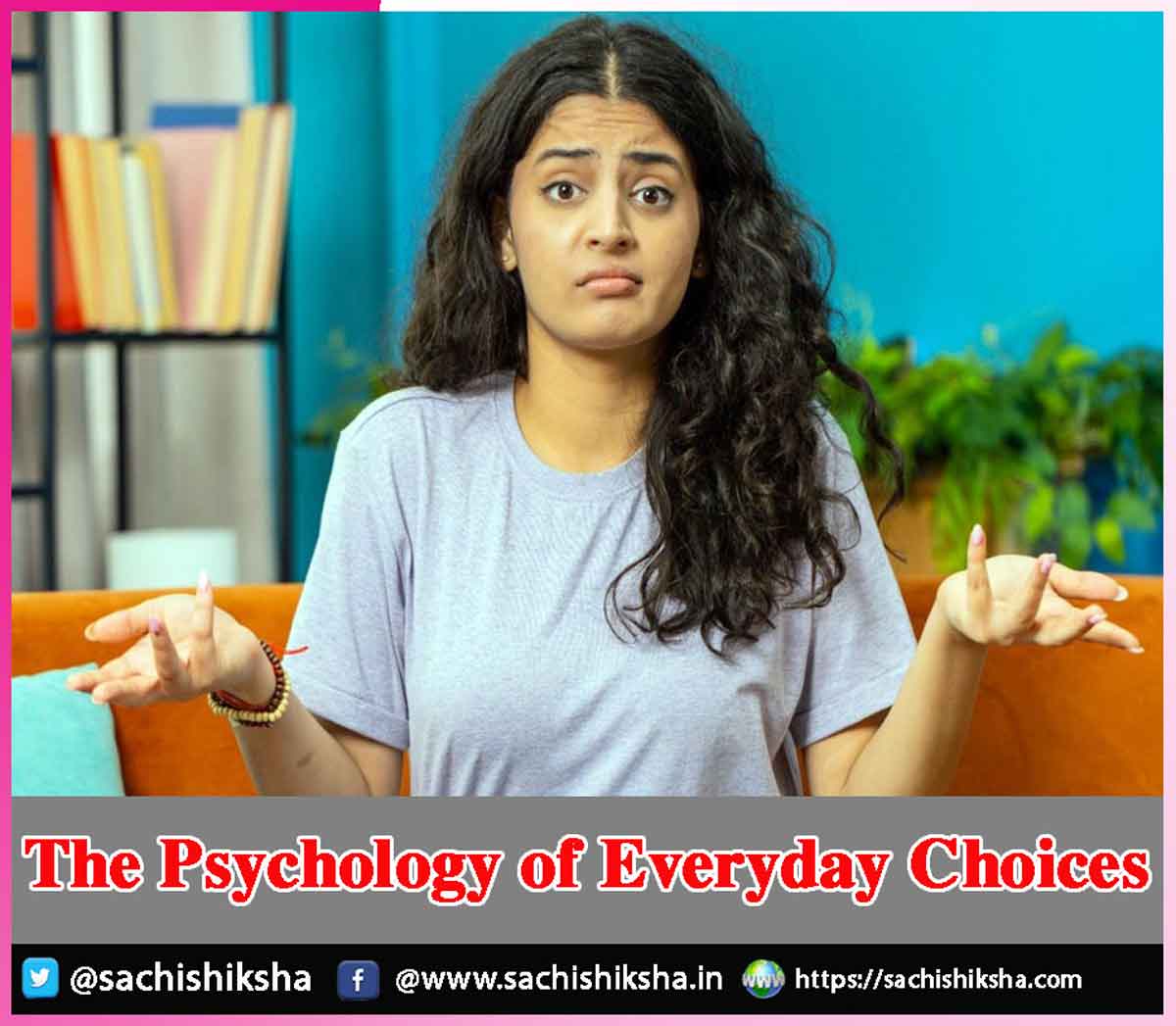
The Psychology of Everyday Choices
Introduction: Why did we choose to do that one particular thing when we could have done something else? Why did we choose pizza over a healthier meal? Why did we save money one month and go on a shopping spree the next? These ordinary decisions may seem trivial, but together they silently shape our daily lives.
Table of Contents
Choices and Habits
We make choices from the very moment we wake up. Some are almost robotic; others require some contemplation. A person may skip the gym because he is tired and because he feels free to make that choice. Another may force himself to go because he knows that skipping once can make skipping again easier. The decision is not only about exercise. It is about habit, reward, effort, mood, and what the person wants his future self to experience in the long run. Research on habits suggests that repeated behaviour can become easier and more automatic over time.
Food and Everyday Decisions
Food gives us another simple example. Someone may knowingly choose junk food because he wants pleasure or convenience, or simply does not want to experience the fear of missing out (FOMO). Someone else may balance his diet because he wants to reduce his future dependence on medicines. Yet that person may also choose a cheat day and enjoy the food he likes. Neither person has completely surrendered his freedom.
The Loop of Choice
Every person uses his liberty to decide differently. Every decision brings an outcome, and that outcome becomes part of the situation in which the next decision is made. Choice somehow ends up creating a loop: we choose, we experience the result, and that result influences what we choose next.
Bounded Rationality
Herbert Simon’s idea of ‘bounded rationality’ may help explain why we do not carefully calculate every decision. Our attention, time, memory, and information are limited, so we often settle for an option that appears sufficiently suitable rather than searching endlessly for the perfect one. Daniel Kahneman’s work similarly distinguishes between quick, intuitive thinking and slower, more deliberate thinking. Much of ordinary life depends on the first kind because constantly analysing everything would be exhausting.
The Influence of Society
Our choices do not happen inside our heads alone. Culture, society, money, and institutions all affect what we choose. Family may influence what we eat, how we speak, and which language we use. Friends may influence what we wear and which shows we watch on Netflix. Economic circumstances may determine what we can afford. At the same time, within the range of available choices, we still exercise our freedom to choose. Even the modern idea of freedom is now being affected by having so many things to choose from.
Choice and Consumer Behaviour
This is also where choice becomes commercially useful. Businesses study what gets our attention, what creates urgency, and what makes a product look popular. Reviews, advertisements, discounts, and limited-time offers are designed to push us towards particular decisions. Even the arrangement of options can change our behaviour without removing our ability to choose.
Conclusion
Therefore, everyday choice is neither completely free nor completely controlled. We have liberty, but we exercise it within circumstances that we did not completely create ourselves. Understanding those circumstances does not take our freedom of choice away. Instead, it helps us recognise why we choose what we choose and perhaps helps us make slightly more conscious choices the next time.